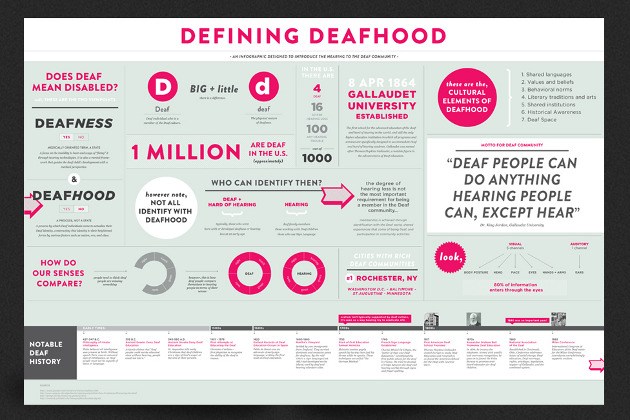
http://cargocollective.com/ellenpeterson/defining-deafhood
My wife is a deaf person who functions like hard of hearing when she uses her hearing devices. When I first met her, her hearing loss was moderate to severe. In the time we have been together, it has deteriorated to the point where she is almost legally deaf. The kind of hearing loss she has means a hearing aid is no longer useful for her. Even the most powerful, $12,000 hearing aids cannot boost her hearing sufficiently. That was why in October last year, she got a cochlear implant.
My first experience with cochlear implants was at the airport many years ago. I remember seeing a family going through the security gates and a young boy of not more than 9 years old being allowed access through a side gate instead of going through the scanner. His hair was cut quite short and on the back of his head was a round plastic disc that was connected to a device clipped to his shirt. Back then I did not know how a cochlear implant worked and in my mind I imagined that beneath the plastic disc was a crater that went all the way to his ear and the plastic disc was used to plugged up the hole. I wondered how they kept it from bleeding and whether skin would grow to cover the sides of the imaginary crater.
It would be years later before I found out how a cochlear implant actually works. It happened when I met the founder of Little Hands Big Voices ( http://littlehandsbigvoices.sg/ ) , a support group for parents of deaf or hard of hearing kids in Singapore. Her son has a cochlear implant on one side and a hearing aid on the other. He also happens to have a full head of curly hair and very clearly no crater in his head. For those who are curious - an electrode is inserted into the head, normally placed behind the ear and connected to the mic outside with the use of magnets.
So how different is it living with someone who is hard of hearing?
For starters, I know I always have to get my wife's attention before beginning a conversation. I normally call her name and wait for her to look at me before I start talking. If not, I wave at her or touch her on the shoulder. Basically she needs to concentrate before she can process any sound she hears. If I happily chat away without getting her attention, she will only register that as background noise or assume I am talking to someone else. Over the years it has become a habit and I never talk to her without letting her know I am going to begin talking to her.
Other than this, I have become very aware of noise and sound. When we go to restaurants or are in any situations where I perceive the volume to be too loud, I often ask Irene if she can hear me or if we need to switch seats. We generally avoid going to places where its too noisy to conduct a conversation
I remember one time she was staying at the hospital with me after I had surgery. I was fortunate enough to be staying at the A class ward as it was covered by insurance and so she could stay over in the sofa bed next to me. In the middle of the night, I woke up and needed her help to get water as I couldn't reach the nurse call bell. I kept calling her, but she didn't even stir because her hearing aids were off. I ended up throwing a pillow at her to wake her up.
One of the biggest challenges came when Zoey was born. Irene couldn't sleep with her hearing aids off because she could not hear Zoey's cries. To her credit, she really wanted to help me with the night feeds, so she slept with at least one hearing aid on for a good part of the first few months.
We are fortunate to live in a time and age where technology is so advanced, it allows us to communicate constantly via text messages. We almost never use the phone as she struggles to hear on it. Instead, when we are apart, we use WhatsApp or Skype messages to remain in constant contact. Over the years we have developed a good communication style using text, so that we never misunderstand the meaning of the words we type, even though we cannot hear each other's tone of voice or see the facial expressions.
When you live with someone with hearing loss, you start to appreciate the small things in life even more. For example, I can hear the rain on the window panes while she can't. I instinctively know when she gets home because I hear her unlocking the padlock on the front gate. I know when the tap in the bathroom is not turned off properly as the dripping sound will annoy me. All things that we take for granted but it is stuff she never hears.

http://www.thatdeafguy.com/
The cochlear implant has improved her hearing to a certain extent and she can now hear things she never could in the past (including some of that annoying Chinese New Year music!). We are going for therapy every month to improve on her hearing and speech skills. On top of this, we have just enrolled in sign language classes. We know that Irene will inevitably completely lose her hearing and so we want to be prepared with a different mode of communication when it happens.
In the meantime, I try as much as possible to enjoy my conversations with Irene and hope with the help of technology, we can continue having such conversations for many years to come.