2 weeks ago, I received an invitation from the US Embassy for an IDAHOT (International Day Against Homophobia and Transphobia) event. The topic for the event was - The Business of Inclusion and it was jointly hosted by the US Embassy, SMU and Barclays. Given the interesting topic and list of panelists, Irene and I decided to attend the event this evening.
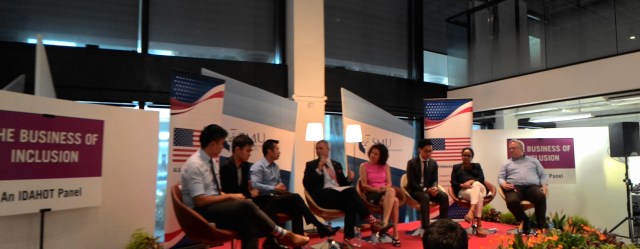
MODERATOR (Centre, holding mic)
Ambassador Kirk Wagar was sworn in as the United States Ambassador to the Republic of Singapore on September 4, 2013.
PANELISTS (Left to right)
Bryan Choong is the Executive Director of Oogachaga, Singapore’s largest counselling and support organisation for the LGBTQ community.
Benjamin Wong is a double-degree undergraduate student and member of Singapore Management University’s Diversity Leadership Development Programme.
Hoon Chang Yau is an Assistant Professor of Asian Studies at Singapore Management University, specialising in religion and multiculturalism in Asia.
Aliza Knox is Managing Director of Online Sales (Asia Pacific and LatAm) at Twitter, responsible for advertising and new channel growth.
Eric Yang is Project Manager for Enterprise Solutions at Bloomberg L.P. and Co-Chair of Bloomberg’s 'BProud' LGBT & Ally Network (Asia Pacific).
Keerthana Mohan is Head of Diversity & Inclusion for Google, Asia Pacific, where she works on inclusion, talent outreach and industry partnership initiatives.
Michael Wollensak is Vice President of Operations at Barclays, heads the Global Futures Brokerage team, and leads Spectrum Singapore, Barclays’ LGBT Employee Network Group.
So what did I learn? This is a quick run down of my own takeaways from the event.
Bryan from Oogachaga shared that local companies are starting the conversation on diversity. However, he cautioned that this is likely to be a long conversation. Benjamin from SMU expressed his concern on how coming out affects a young person's career growth. Even if a company professes to be diverse, if the mindset of people are not changed, attitudes will not change. Chang Yau from SMU reminded the audience that Asian culture has a long history of having many different types of families and gender identities. It's actually part of many cultures, but washed away when colonialism happened. Ma jies anyone?
It was heartening to see big companies like Twitter, Google, Bloomberg and Barclays recognise that in order to gain access to and retain top talents, diversity is important. Not just in the US, but all over the world. I'm so glad that all 4 of these companies are sponsors of Pink Dot ( http://pinkdot.sg ) this year. Truly walking the talk.
Aliza from Twitter shared how when she first came to Singapore in the 90s, her husband couldn't even get a dependent pass because the government didn't think men would be the tag-a-long spouse. She believes that big corporations are part of a slow but ongoing conversation with the government on how to work on expanding diversity inclusion. Eric Yang from Bloomberg shared how he came to start up BProud because he found that it didn't exist in Asia when he was posted to Singapore. Keerthana Mohan from Google shared how Google believes in celebrating your whole self and allowing people to bring their whole self to work. It was also interesting to find out that one of the ways they have managed to promote diversity in their culture is to make sure that attendance for diversity events are non-negotiable and they used families (for example bringing in gay people and their mothers) to kick start the LGBT conversation. Michael Wollensak from Barclays shared how he felt fortunate that they were able to find supporters and sponsors for Spectrum Singapore and that they now have the infrastructure in place to continue the conversation even if key people leave Barclays. We also met Anthony from Goldman Sachs during the networking session after the panel. He shared with us how they handled the fallout from their much publicised LGBT recruitment dinner last year ( http://www.bbc.com/news/world-asia-27584565 ) . Their global CEO has been a vocal supporter of LGBT rights and this empowered the local office to stay true to their values. How awesome is that?
Vanessa from Project X ( http://theprojectx.org/ ) closed with her comment that this panel discussion was valid for people of privilege, but we must not forget that there are many more LGBT people who are not in the position to work in companies that are so inclusive. It was a really good reminder, so thank you Vanessa for standing up and speaking out!
We met many people this evening, including some students from NUS (shout out to Junie and Zen, doing great work in tFreedome, their NUS Tembusu college support group for LGBTs!) and Paul Broom from the British High Commission. I know we are so fortunate to have all these dynamic people supporting our cause in Singapore and there is hope that things will get better.
I hope most of the big MNCs will stay true to their commitment to be as inclusive as possible and not sing a different song when they are called out on it. I believe there needs to be less fear and more important conversations happening. As Anthony from Goldman Sachs pointed out, Goldman Sachs have held true to their values and continued to hold their recruitment drives and do sponsorship of events such as Pink Dot. Nothing has happened to them and they have not been kicked out of the country. So businesses don't need to be so afraid. I think it's time for more businesses to show that they are aware of the importance of diversity and that they are inclusive as well. The big companies are leading the way, but I am sure many small companies can show their support as well, simply by stating that they are an equal opportunity employer.
The business of inclusion, is important for all businesses, big and small.