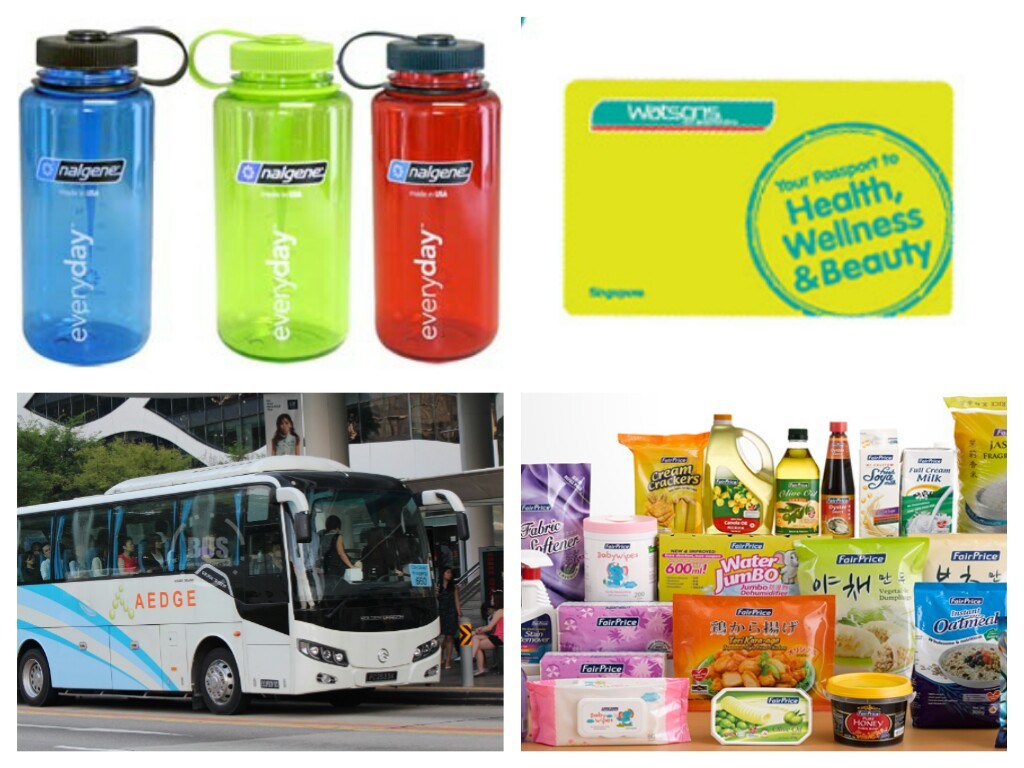
Images respective copyright of Nalgene ( http://nalgene.com/ ) , Watsons Singapore ( http://www.watsons.com.sg/ ) , AEDGE holdings ( http://www.aedge.com.sg/aedgeholdings.html ) and NTUC Fairprice ( http://www.fairprice.com.sg/webapp/wcs/stores/servlet/en/fairprice )
Living in Singapore is not cheap and I am always looking for ways to save money on daily expenses. Here are 5 simple ways.
1) Carry a water bottle
The cafe industry is raking in the big bucks on drinks. I personally don't drink coffee, but Irene does. While she prefers local coffee to Starbucks, I know of many others who drink Starbucks daily.
Example - $5.50 for a cappuccino at Starbucks in the mornings. Multiply that by 20 working days and its $110 a month. Consider the cheaper alternative, $1.50 for kopi at your local coffee shop. Multiply that by 20 working days and it's $30 a month.
The drinks stall is the number one money making stall in any coffee shop or food court. The profit margin on drinks is insane and the amount we spend can quickly add up.
Example - $1.50 for a cup of ice lemon tea during lunch at a food court. Multiply that by 20 working days and it's $30 a month.
That's anything between $60 to $140 you can save a month just by bringing your water bottle, not counting the health benefits of drinking plain water. You can also opt to bring your own coffee or iced tea to work for a fraction of the price.
2) Take mass public transport
There's a difference between taking public transport and taking mass public transport. We don't have a car and I try as much as possible not to take taxis either. The cost of taxis can easily be 5 to 10 times the cost of taking the bus or MRT. For example, taking the bus and MRT from our home to CBD costs around $1.90. Taking a taxi during morning peak hour with the ERP on the CTE is around $20. Ten times the cost and I don't really save all that much time because of the terrible morning traffic.
Wanting to take mass public transport also means being very aware of the amount of time it takes from point A to point B and buffering extra time for the waiting and potential breakdowns. I generally use http://gothere.sg/ to gauge the amount of time it will take and add 15 mins buffer just in case. While this means a long commute sometimes, I try to make full use of the time by listening to podcasts or having reading material ready.
A little known alternative for the people working in the CBD area is the Bus Service Enhancement Programme. The government started this initiative some time last year to ease the strain on the public transportation system. As part of this programme, some private bus companies are given subsidies to ply certain routes during peak hours. I take private bus number 660 that goes from our home in Hougang to CBD for just $2.14 per trip. It's a comfortable ride that uses CTE and gets me to town in about 40 minutes, saving me 20 mins of travel time as compared to taking the MRT and it only costs $0.24 more. The catch is the bus only runs at 730, 740 and 750 am so if you miss it, you are out of luck.
3) Make use of memberships and rewards cards
I have many membership and rewards cards. This includes NTUC Link, Passion, Watsons, Kiddy Palace, Popular, KOI, IKEA, TCC, Kopitiam etc. My criteria when deciding which membership programs to join is if it's free, go ahead and sign up. If you need to pay, consider how much it costs and figure out if you will be able to recoup that amount within the validity of the card. If not, don't bother.
The good thing about most of these cards is they offer rebates, discounts and sometimes special treats such as member only sales. The main problem is having to carry so many cards around. My solution to that is only carrying the cards I use often. For the others, I only take them out when I know I will use them. Places such as Watsons allows you to give your NRIC to accumulate points and you only need your card when you want to redeem the points.
4) Consider cheaper alternatives
I use body wash as hand wash. It's cheaper than hand wash and comes in bigger bottles.
I use house brands. I often find they are just as good as the "name" brands and they can be around 30% to 50% cheaper.
I make our own snacks as detailed in this post ( http://olivia.thechiongs.com/2015/03/07/healthy-homemade-snacks/ ) . We save quite a bit and eat healthier at the same time.
Before I buy something new, I always try and see if I can buy it secondhand. I've saved quite a bit buying big items such as our washing machine and dryer at just $50. Zoey's cot was bought preloved at $80 instead of $240.
So do consider if there are other items you can make do with cheaper alternatives.
5) Keep a price list
For the products we buy often, I keep a list of the normal price and the sale prices. Especially for products that we can purchase in bulk and keep such as toilet paper, tissue paper and diapers. This way whenever I see the items on sale, I can check to see if the sale price is truly a sale. When I find that it is on a reasonable discount based on the history, I tend to stock up on it. This works for many items including toiletries and everyday household stuff like laundry detergent. They are non-perishable so you don't have to worry about it spoiling and therefore can purchase it at the best price. It certainly beats running out of the items and having to pay full price for it.
There you have it, 5 simple ways to save on some daily expenses. I know some of the savings seem to be quite little, but every bit counts and I find that it does add up. Try some of it and see if any of it works for you.