I've been putting off writing a post about Mr Lee Kuan Yew's passing. I feel that while I have benefited from the Singapore he has helped to build, I don't really have anything special to contribute as compared to all the tributes written so far.
I've never met Mr Lee Kuan Yew and the closest connection I have to him is watching his father, Mr Lee Chin Koon, swim laps at Singapore Swimming Club when I was a child. There would always be a couple of bodyguards watching over him and I remember thinking that Mr Lee Kuan Yew looked a lot like his father.
Fast forward to January 2011. Irene and I were interviewed by Elgin Toh of the Straits Times regarding remarks Mr Lee Kuan Yew had written in his book "Hard Truths to Keep Singapore Going. ( http://www.selectbooks.com.sg/getTitle.aspx?SBNum=050737 ) "
The relevant paragraphs are on page 377 of the book and I quote:
> Page title: "Homosexuality - It's in the genes"
>
> Preamble from the editors: "As in many societies, the issue of homosexuality is controversial in Singapore. From the heated parliamentary debates in 2007 over whether to retain or repeal Section 377A of the Penal Code, which prohibits sex between men (it was eventually retained), to the unease over homosexual content in student sex education manuals, the subject polarises the public. It was no surprise then that we received questions on this topic from both sides of the conservative-liberal divide, including one that asked how Lee would feel if one of his grandchildren were gay."
>
> Q: What is your personal view on being gay? Do you think it's a lifestyle or is it genetic?
>
> A: No, it's not a lifestyle. You can read the books all you want, all the articles. There's a genetic difference, so it's not a matter of choice. They are born that way and that's that. So if two men or two women are that way, just leave them alone. Whether they should be given rights of adoption is another matter because who's going to look after the child? Those are complications that arise once you recognise that you could actually legally marry, then you say I want to adopt. Vivian Balakrishnan says it's not decisively proven. Well, I believe it is. There's enough evidence that some people are that way and just leave them be.
>
> Q: This is more of a personal question, but how would you feel if one of your grandchildren were to say to you that he or she is gay?
>
> A: That's life. They're born with that genetic code, that's that. Dick Cheney didn't like gays but his daughter was born like that. He says, "I still love her, full stop." It's happened to his family. So on principle he's against it, but it's his daughter. Do you throw the daughter out? That's life. I mean none of my children is gay, but if they were, well that's that.
>
> Q: So what do you see is an obstacle to gay couples adopting children? You said, who's going to look after the child?
>
> A: Who is going to bring them up? Two men looking after a child? Two women looking after a child, maybe. But I'm not so sure because it's not their own child. Unless you have artificial insemination and it's their own child, then you have a certain maternal instinct immediately aroused by the process of pregnancy. But two men adopting a boy or a girl, what's the point of it? These are consequential problems, we cross the bridge when we come to it. We haven't come to that bridge yet. The people are not ready for it. In fact, some ministers are not ready for it. I take a practical view. I said this is happening and there's nothing we can do about it. Life's like that. People are born like that. It's not new, it goes back to ancient times. So I think there's something in the genetic makeup.
>
> Q: It took time for Singaporeans to be able to accept single women MPs. Do you see Singaporeans being able to accept a gay MP? It's already happening in a fairly widespread fashion in Europe.
>
> A: As far as I'm concerned, if she does her work as an MP, she looks after her constituents, she makes sensible speeches, she's making a contribution, her private life is her life, that's that. There was a British minister, I shouldn't name him, a Conservative. He was out of office but he was hoping to become the leader of the party and we had dinner with a few friends. He thought he had to come out upfront that when he was at university at Oxford, he did get involved in same-sex activities. But he's married now with children, he's quite happy. So he came out with it. He didn't become leader of the party and that's Britain. He thought he had come out upfront and it'd protect him from investigative reporting. It did not help him. But had he kept quiet they would have dug it out, then it's worse for him. So there you are. You know, there are two standards. It's one thing the people at large, it's another thing, your minister or your prime minister being such a person. I mean Ted Heath was not married. I shouldn't say who the ministers were who said he's a suppressed homosexual. So the opposition party leaders were telling me because it's very strange. Here's a man in the prime of his life and getting on, 40, 50 still not married, and he was that way at Oxford. So they said, suppressed homosexual. That's the opposition talk by very reputable leaders who tell me that seriously. So? And with it of course is disapprobation, that he's unworthy to be a leader. But that was in the early 1970s.
>
> Q: Did you come to this view on homosexuality just through scientific reasoning alone?
>
> A: No, by my observation and historical data. I mean, in the Ottoman empire, they had a lot of it. And there was one story that D. H. Lawrence was captured in Arabia and they sodomised him. The Ottomans had their share of homosexuals and I'm sure there were also women in the harems. So? So be it.
>
> Q: What about your acquaintances or your friends growing up throughout life, were any of them gay as well?
>
> A: I'm not sure about acquaintances, but not my friends. I mean, they were all married. But I'm sure there must have been. This is not something which is recent, it goes back into historic times. And you have animals sometimes acting that way. So it's not just human beings, there's something in the genetic code.
>
> Q: So this is one aspect where the conservative views of society are diametrically opposed to your own practical views?
>
> A: I'm not the prime minister, I told you that before I started. If I were the prime minister I would hesitate to push it through against the prevailing sentiment, against the prevailing values of society. You're going against the current of the people, the underlying feeling. What's the point of that, you know, breaking new ground and taking unnecessary risk? It will evolve over time, as so many things have, because after a while my own sort of maturing process will take place with other people. You don't just live and then you cut off your ideas after a certain time. You keep on living and you watch people and you say, 'Oh that's the way life is.'
>
> Q: But are you, personally speaking, frustrated by this conservatism?
>
> A: No, I take a purely practical view.
>
> Q: But are you frustrated by how this conservatism is perhaps opposed to the practical view?
>
> A: No, that is life. I cannot change them overnight. I think society, their own experiences, their own reading, their own observations, will bring about the change despite their innate biases.
While I am glad he took the stance that being gay is genetic, I thought he was being quite dismissive of adoptive parents. Irene was quoted in the Straits Times regarding this point - "If MM Lee is right, then even heterosexual couples should not be allowed to adopt, because they, too, have no biological connection with the child. I think adoption is a great act of love, and there is no reason to expect adoptive parents to be any less caring.'"
You can read the whole Straits Times article and more about Mr Lee Kuan Yew's view on homosexuality here: http://sgwiki.com/wiki/Lee_Kuan_Yew's_views_on_homosexuality
The actual article was edited quite a bit before being published and they didn't even use the photo they had made us take with the ST photographer. This is after the discussion Irene and I had about coming out on the Straits Times and they ended up not even using the photo. All that anxiety for nothing!
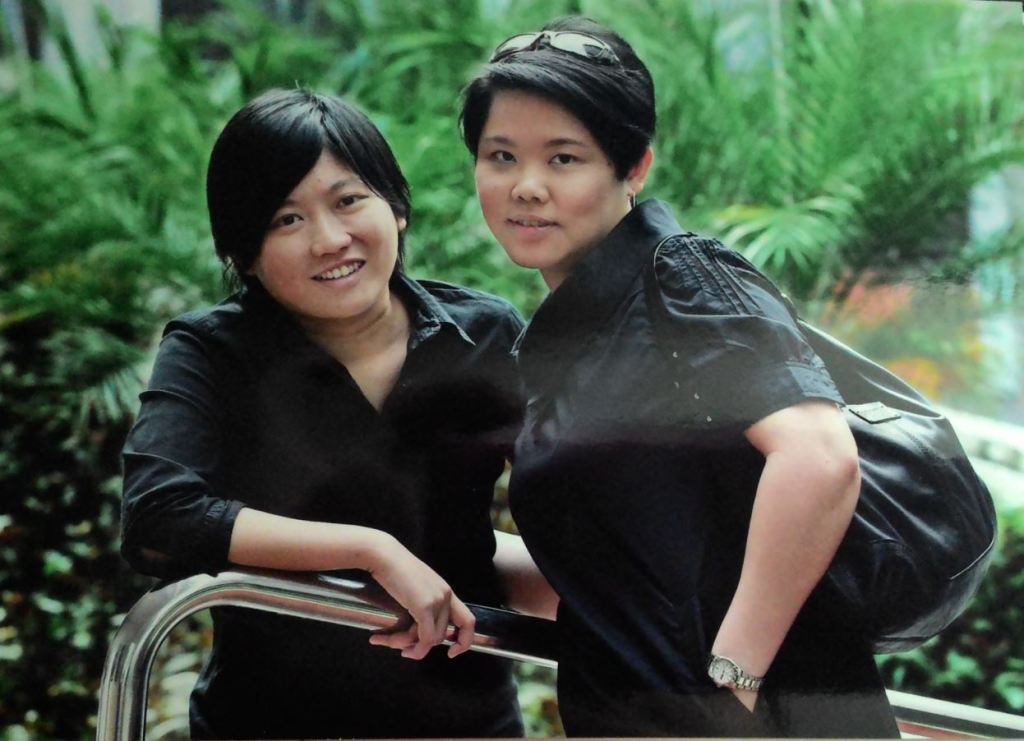
Photo credit: Straits Times photographer
I look back at that article now and marvel that in the 4 years since, we've actually gone and had a baby. We did it the way he thought it should be done using "artificial insemination and it's their own child, then you have a certain maternal instinct immediately aroused by the process of pregnancy." However, I still don't think we have more maternal instinct than our friends who did surrogacy or adoption.
So my tribute to Mr Lee Kuan Yew is this - I hope I am contributing to change that he predicted. He was a practical man who recognised that it is a matter of time. What society needs is more experiences, readings and observations of lgbt people and their families. I like to think that it has started, given the fairly positive coverage we received in the Straits Times ( http://news.asiaone.com/news/travel/family-travel-policies-gay-partners ) about the MSIG travel insurance claim, ( http://olivia.thechiongs.com/2015/02/26/msig-is-my-new-favourite-insurer/ ) All it needs is more people to stand up and be counted. It's inevitable and in time, change will come.